Chun Zu
Chun Zu CBF Series Bolt Formers
Model CBF Series
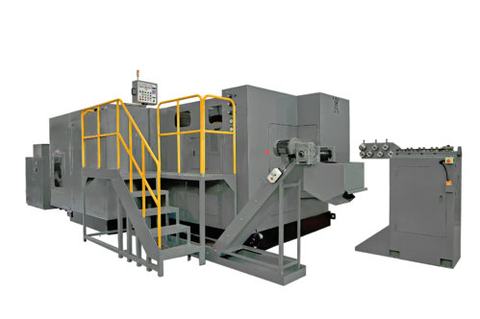
Chun Zu CBF series bolt formers: 3- and 4-station cold formers for bolts and headed fasteners across industries, from 16,000 to 430,000 kg of forging load.
Chun Zu
Model CBF Series
Chun Zu CBF series bolt formers: 3- and 4-station cold formers for bolts and headed fasteners across industries, from 16,000 to 430,000 kg of forging load.
Chun Zu bolt formers in the CBF series are 3- and 4-station cold formers for making bolts and other headed fasteners. The series covers 23 models, from the CBF-43S, which forms bolts of 2 to 4 mm, to the CBF-254L, which forms bolts up to 25.4 mm and applies up to 430,000 kg of forging load.
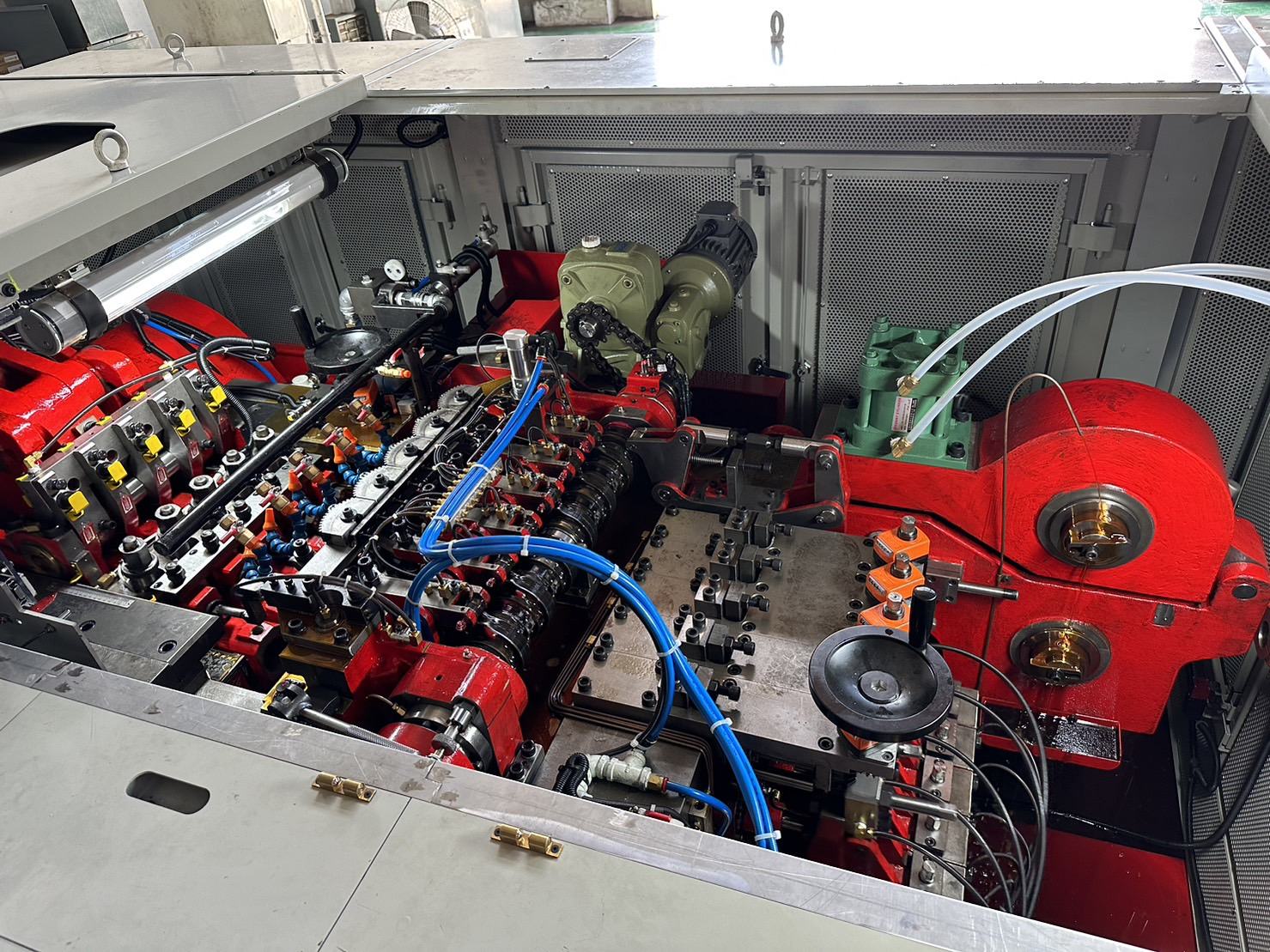
A bolt former shapes metal at room temperature. Wire is fed from a coil, cut to length, and moved from station to station, where punches and dies upset the head and form the shank, so a bolt blank leaves the machine on every stroke. Because the metal is displaced rather than cut away, the process wastes very little material, and the part keeps a continuous grain flow that adds strength.
A bolt former is chosen by the size of the bolt, the length of the part, the material and the forging load the part needs. The sections below explain how a bolt former works, how to narrow the range, and the model tables compare every machine in the series.
Every CBF model follows the same cold forming cycle, repeated on each stroke of the machine:
The dies and punches are the tooling that gives the part its shape, and they are changed to switch from one part to the next. The machine supplies the force, speed and repeatability.
Cold forming is the standard way to make bolts and other headed fasteners in volume, and a Chun Zu bolt former is built to make the most of it.
The ranges below cover all 23 CBF models, split by the number of forging stations.
| Specification | 3-station models | 4-station models |
|---|---|---|
| Number of models | 8 | 15 |
| Max. forging load | 16,000 to 115,000 kg | 16,000 to 430,000 kg |
| Max. cut-off diameter | Ø5 to Ø15 mm | Ø5 to Ø30 mm |
| Max. cut-off length | 66 to 250 mm | 66 to 360 mm |
| Max. speed | 100 to 300 ppm | 62 to 300 ppm |
| Motor power | 10 to 40 hp | 10 to 125 hp |
| Nominal bolt size | 2 to 12.7 mm | 2 to 25.4 mm |
| Shank length | 6 to 210 mm | 6 to 305 mm |
| Machine weight | 5,600 to 31,000 kg | 6,500 to 131,000 kg |
Ranges run from the smallest to the largest model in each group.
A bolt former is not tied to one market. Any industry that uses headed fasteners or similar formed parts in volume can run them, from everyday hardware to safety-critical components. The CBF series runs from light machines for small bolts to 430,000 kg machines for large parts, so it covers the range between those ends as well.
The same machines run standard bolts and custom-designed parts, such as flanged, hex, round-head, stepped-shank and other special-shape bolts. Send us the part drawing, material and annual volume and we will help you match a model.
Forging load is the force the machine puts into the metal on each blow. The more metal a part contains, and the stronger or harder that metal is, the more force it takes to move it. That is why the CBF series scales from 16,000 kg to 430,000 kg of forging load: larger models take a larger wire diameter, up to 30 mm of cut-off diameter, and have the force to form harder materials.
Bolts are commonly cold formed from low and medium carbon steel, alloy steel for high-strength grades, and stainless steel, along with softer metals such as aluminum, brass and copper. Wire is usually annealed and lubricated before forming so that it flows into the die without cracking. For the same bolt size, an alloy or stainless steel needs more force than low-carbon steel, so for harder materials choose a model with forging load to spare instead of one sized right at the limit.
Bigger models do more than form bigger bolts. The extra load and the heavier frame also give you room to form harder materials, longer parts and heavier heads at a steady speed. Send us your material grade and bolt size and we will help you choose.
The number of stations follows how complex the part is. In a single blow, metal can only be moved so far before it work-hardens and risks cracking, and the tooling takes more strain the harder it is pushed. A part with a simple geometry, such as a plain round or hex head on a straight shank, can be formed in fewer blows. A part with a large head, a flange, or several steps in the shank is formed in stages: each station makes one blow and brings the shape closer to the finished geometry. More stations means more blows, which means more complex shapes can be formed without overstraining the metal or the dies.
The CBF series has 8 three-station models and 15 four-station models. The three-station models cover the smaller end of the range: up to 115,000 kg of forging load, cut-off diameters up to 15 mm and bolts up to 12.7 mm, with 10 to 40 hp motors.
The four-station models cover the full range: 16,000 to 430,000 kg of forging load, cut-off diameters up to 30 mm and bolts up to 25.4 mm. They also include the machines for the longest parts, with cut-off lengths up to 360 mm.
In the smaller sizes you can compare both. The CBF-43S and CBF-44S, for example, share the same 16,000 kg forging load, 5 mm cut-off diameter and 300 ppm top speed; the CBF-44S adds a fourth station, at a machine weight of 6,500 kg against 5,600 kg. If you are unsure which suits your part, send us the drawing and we will help you decide.
Match your bolt diameter to the nominal bolt size range of each model. Where a size appears in more than one row, also check forging load, cut-off length and speed in the full comparison table below.
| Nominal bolt size (mm) | 3-station models | 4-station models |
|---|---|---|
| 2 to 4 | CBF-43S | CBF-44S |
| 3 to 6 | CBF-63S | CBF-64S |
| 5 to 8 | CBF-83S, CBF-83L | CBF-84S |
| 6 to 10 | CBF-103S, CBF-103L | CBF-104S, CBF-104L |
| 8 to 12.7 | CBF-133S, CBF-133L | CBF-134S, -134L, -134LL |
| 10 to 16 | — | CBF-164S, CBF-164LL |
| 12 to 20 | — | CBF-204S, -204L, -204LL |
| 14 to 25.4 | — | CBF-254S |
| 16 to 25.4 | — | CBF-254L |
Many size classes in the CBF series offer more than one model. The suffix shows how long a part the machine cuts: S models cut the shortest lengths and run fastest, L models cut longer parts, and LL models cut the longest. The longer cut-off length comes at the cost of speed and a heavier machine.
Choose a long or extra-long model when your bolts need a long shank. Shank lengths reach 305 mm on the CBF-164LL and CBF-204LL. For shorter parts, the standard model in the same size class runs faster.
Review the specifications of our flagship models.
| Model | No. of Forging Stations | Max. Forging Load (Kg) | Max. Cut-off Diam. (mm) | Max. Cut-off Length (mm) | Max. Speed (ppm) | P.K.O Stroke (mm) | K.O Stroke (mm) | Motor Power (hp) | Cut-off Die Diam. (mm) | Punch Die Diam. (mm) | Main Die Diam. (mm) | Machine Weight (Kg) | Nominal Bolt Size (mm) | Shank Length (mm) |
|---|---|---|---|---|---|---|---|---|---|---|---|---|---|---|
| CBF-43S | 3 | 16,000 | Ø5 | 66 | 300 | 10 | 56 | 10 | Ø38x30L | Ø31x65L | Ø38x85L | 5,600 | 2-4 | 6-50 |
| CBF-63S | 3 | 35,000 | Ø8 | 70 | 260 | 12 | 52 | 15 | Ø30x45L | Ø40x90L | Ø50x85L | 7,500 | 3-6 | 10-50 |
| CBF-83S | 3 | 60,000 | Ø10 | 75 | 240 | 12 | 52 | 20 | Ø53x56L | Ø45x95L | Ø60x80L | 10,000 | 5-8 | 15-50 |
| CBF-83L | 3 | 60,000 | Ø10 | 135 | 180 | 16 | 115 | 25 | Ø30x50L | Ø45x140L | Ø60x150L | 14,000 | 5-8 | 25-107 |
| CBF-103S | 3 | 80,000 | Ø12 | 105 | 200 | 15 | 80 | 25 | Ø45x59L | Ø53x115L | Ø75x108L | 14,000 | 6-10 | 15-70 |
| CBF-103L | 3 | 80,000 | Ø12 | 192 | 140 | 15 | 162 | 30 | Ø45x59L | Ø53x112L | Ø75x200L | 19,500 | 6-10 | 30-152 |
| CBF-133S | 3 | 115,000 | Ø15 | 145 | 160 | 26 | 102 | 40 | Ø63x69L | Ø60x130L | Ø86x135L | 19,500 | 8-12.7 | 20-100 |
| CBF-133L | 3 | 115,000 | Ø15 | 250 | 100 | 25 | 230 | 40 | Ø55x70L | Ø60x179L | Ø86x265L | 31,000 | 8-12.7 | 70-210 |
| CBF-44S | 4 | 16,000 | Ø5 | 66 | 300 | 10 | 56 | 10 | Ø42x30L | Ø31x65L | Ø38x85L | 6,500 | 2-4 | 6-50 |
| CBF-64S | 4 | 40,000 | Ø8 | 95 | 240 | 12 | 80 | 20 | Ø30x45L | Ø40x90L | Ø50x110L | 10,000 | 3-6 | 10-75 |
| CBF-84S | 4 | 60,000 | Ø10 | 100 | 200 | 19 | 85 | 30 | Ø35x50L | Ø45x115L | Ø60x120L | 14,500 | 5-8 | 15-77 |
| CBF-104S | 4 | 80,000 | Ø12 | 133 | 160 | 20 | 110 | 30 | Ø45x59L | Ø53x115L | Ø75x135L | 18,000 | 6-10 | 15-102 |
| CBF-104L | 4 | 80,000 | Ø12 | 185 | 150 | 30 | 160 | 40 | Ø45x59L | Ø53x115L | Ø75x185L | 21,000 | 6-10 | 20-152 |
| CBF-134S | 4 | 120,000 | Ø15 | 140 | 150 | 26 | 102 | 40 | Ø63x69L | Ø60x130L | Ø68x135L | 21,000 | 8-12.7 | 20-100 |
| CBF-134L | 4 | 120,000 | Ø15 | 190 | 120 | 30 | 160 | 50 | Ø63x69L | Ø60x178L | Ø86x190L | 26,000 | 8-12.7 | 25-152 |
| CBF-134LL | 4 | 120,000 | Ø15 | 285 | 80 | 30 | 280 | 50 | Ø55x70L | Ø60x229L | Ø86x305L | 38,000 | 8-12.7 | 75-262 |
| CBF-164S | 4 | 210,000 | Ø18 | 195 | 110 | 30 | 170 | 60 | Ø60x90L | Ø75x185L | Ø100x190L | 43,000 | 10-16 | 20-152 |
| CBF-164LL | 4 | 210,000 | Ø18 | 350 | 70 | 46 | 320 | 75 | Ø64x100L | Ø75x185L | Ø100x345L | 60,000 | 10-16 | 100-305 |
| CBF-204S | 4 | 350,000 | Ø23 | 195 | 95 | 46 | 170 | 75 | Ø75x120L | Ø90x215L | Ø125x200L | 62,000 | 12-20 | 25-152 |
| CBF-204L | 4 | 350,000 | Ø23 | 240 | 80 | 46 | 220 | 75 | Ø75x120L | Ø90x215L | Ø125x240L | 62,000 | 12-20 | 25-200 |
| CBF-204LL | 4 | 350,000 | Ø23 | 360 | 65 | 46 | 325 | 100 | Ø75x120L | Ø90x215L | Ø125x345L | 75,000 | 12-20 | 100-305 |
| CBF-254S | 4 | 430,000 | Ø26 | 253 | 70 | 40 | 175 | 125 | Ø80x130L | Ø120x270L | Ø140x250L | 105,000 | 14-25.4 | 35-175 |
| CBF-254L | 4 | 430,000 | Ø30 | 320 | 62 | 46 | 280 | 125 | Ø99x150L | Ø120x270L | Ø148x300L | 131,000 | 16-25.4 | 60-254 |
Nominal bolt size and shank length are shown as minimum-maximum ranges.
Tooling for the CBF series is sized by model. The cut-off die, punch die and main die sizes below are for the standard (S) model in each size class. Cinco supplies dies, punches and other tooling for cold formers; see our fastener tooling page, or send us your die drawings.
| Model | Cut-off die (mm) | Punch die (mm) | Main die (mm) |
|---|---|---|---|
| CBF-43S | Ø38x30L | Ø31x65L | Ø38x85L |
| CBF-63S | Ø30x45L | Ø40x90L | Ø50x85L |
| CBF-83S | Ø53x56L | Ø45x95L | Ø60x80L |
| CBF-103S | Ø45x59L | Ø53x115L | Ø75x108L |
| CBF-133S | Ø63x69L | Ø60x130L | Ø86x135L |
| CBF-164S | Ø60x90L | Ø75x185L | Ø100x190L |
| CBF-204S | Ø75x120L | Ø90x215L | Ø125x200L |
| CBF-254S | Ø80x130L | Ø120x270L | Ø140x250L |
L and LL models use longer main dies for their longer cut-off lengths. See the full comparison table for every model.
Plan the installation by size class. Forging load, motor power and machine weight rise together across the series, and the K.O. (knock-out) stroke grows with the cut-off length, from 52 mm on the shortest models to 325 mm on the CBF-204LL. Values below are for the standard (S) model in each class.
| Model | Max. forging load (kg) | Motor power (hp) | Machine weight (kg) | P.K.O stroke (mm) | K.O stroke (mm) |
|---|---|---|---|---|---|
| CBF-43S | 16,000 | 10 | 5,600 | 10 | 56 |
| CBF-63S | 35,000 | 15 | 7,500 | 12 | 52 |
| CBF-83S | 60,000 | 20 | 10,000 | 12 | 52 |
| CBF-103S | 80,000 | 25 | 14,000 | 15 | 80 |
| CBF-133S | 115,000 | 40 | 19,500 | 26 | 102 |
| CBF-164S | 210,000 | 60 | 43,000 | 30 | 170 |
| CBF-204S | 350,000 | 75 | 62,000 | 46 | 170 |
| CBF-254S | 430,000 | 125 | 105,000 | 40 | 175 |
A bolt former is one part of a production line. These Cinco product lines work alongside it.
Chun Zu has been a pioneer in the cold forming industry for over four decades, continually refining its technology to meet the needs of manufacturers around the world. As Taiwan's fastener industry has expanded, Chun Zu has developed one of the most comprehensive lineups of bolt formers available.
With over 10,000 units shipped to more than 50 countries, Chun Zu has built a global reputation for quality and customer satisfaction. Cinco Industries supplies Chun Zu cold forming machines to fastener manufacturers. See the Chun Zu cold forming machines overview for the full range.
The CBF series is Chun Zu's range of 3- and 4-station bolt formers: 23 models from 16,000 to 430,000 kg of forging load, for bolts from 2 to 25.4 mm.
A bolt former is a multi-station cold forming machine. It cuts a blank from coil wire and moves it through a series of dies, where punches form the head and shank at room temperature. It makes a finished bolt blank on every stroke with very little scrap.
Any industry that uses headed fasteners or formed parts in volume: automotive and transportation, construction, machinery and equipment, energy and infrastructure, electrical and appliances, furniture and general hardware. The CBF series runs standard bolts and custom-designed parts.
It depends on how complex the part is. Metal can only be moved so far in one blow, so a more complex geometry needs more stations to form it in steps. Three-station models cover bolts up to 12.7 mm and forging loads up to 115,000 kg. Four-station models cover the full range, up to 25.4 mm bolts and 430,000 kg. Send us your part drawing and we will help you decide.
Bolts are commonly cold formed from low and medium carbon steel, alloy steel and stainless steel, along with softer metals such as aluminum, brass and copper. Harder materials need more forging load for the same part, so choose a model with load to spare. Tell us your material grade and we will help you size the machine.
Larger bolts contain more metal, so they take a larger wire diameter and more forging load. Across the CBF series, forging load rises from 16,000 kg to 430,000 kg and cut-off diameter from 5 mm to 30 mm as the bolts grow from 2 mm to 25.4 mm. The larger machines can also form harder materials.
The CBF-254S forms bolts of 14 to 25.4 mm nominal size and the CBF-254L forms 16 to 25.4 mm, both with 430,000 kg of forging load. The CBF-254L has the largest cut-off diameter in the series, 30 mm.
Within a size class, the suffix shows how long a part the machine cuts. S models cut the shortest lengths and run fastest. L and LL models cut longer lengths at lower speeds and a higher machine weight. For example, the CBF-103S cuts 105 mm at 200 ppm, while the CBF-103L cuts 192 mm at 140 ppm.
Shank lengths run from 6 mm on the smallest models to 305 mm on the CBF-164LL and CBF-204LL. The longest cut-off length in the series is 360 mm, on the CBF-204LL.
A bolt former makes the head and shank. Threads are normally rolled in a second operation on a thread rolling machine. See our thread rolling machines for flat die and cylindrical die options.
Both are Chun Zu bolt formers. The CBF series has three and four stations. The CBP series bolt part formers come in five- and six-station models. They are used in place of each other, not together, so compare both pages or send us your part and we will recommend one.
Yes. Helm tonnage monitors are used on multi-station cold formers to watch forming load and flag faults such as misfeeds and broken inserts. See Helm tonnage monitors for cold forming machines.
Cinco supplies cold heading dies, punches and other tooling for cold formers. Browse our fastener tooling page, or send us your die drawings and the model you run.
Send the part drawing or sample, the material and wire diameter, the head style and bolt length, the volume you plan to run, and the machine you use today. We will recommend a CBF model.
Tell us about your parts and we will help you choose a CBF model.